
Half Here, Half Somewhere Else - Why multitasking doesn't work, and what it quietly does to the man you are
Flow state
You sit down to write an important email. A video is playing in another tab. A message pops up, so you answer it. Your phone buzzes in your pocket. You reply to that too. Then, almost without noticing, you're scrolling social media.
Half an hour later you look back at the email. You can't remember what you were trying to say.
That scene comes from Ikigai by Héctor García and Francesc Miralles. It sits in a chapter about finding flow in everything you do. They give a gentler version as well. You eat dinner in front of a film and only realise how good the food was on the last mouthful.
Most of the men I work with would recognise it straight away.
It starts with what you're aiming at
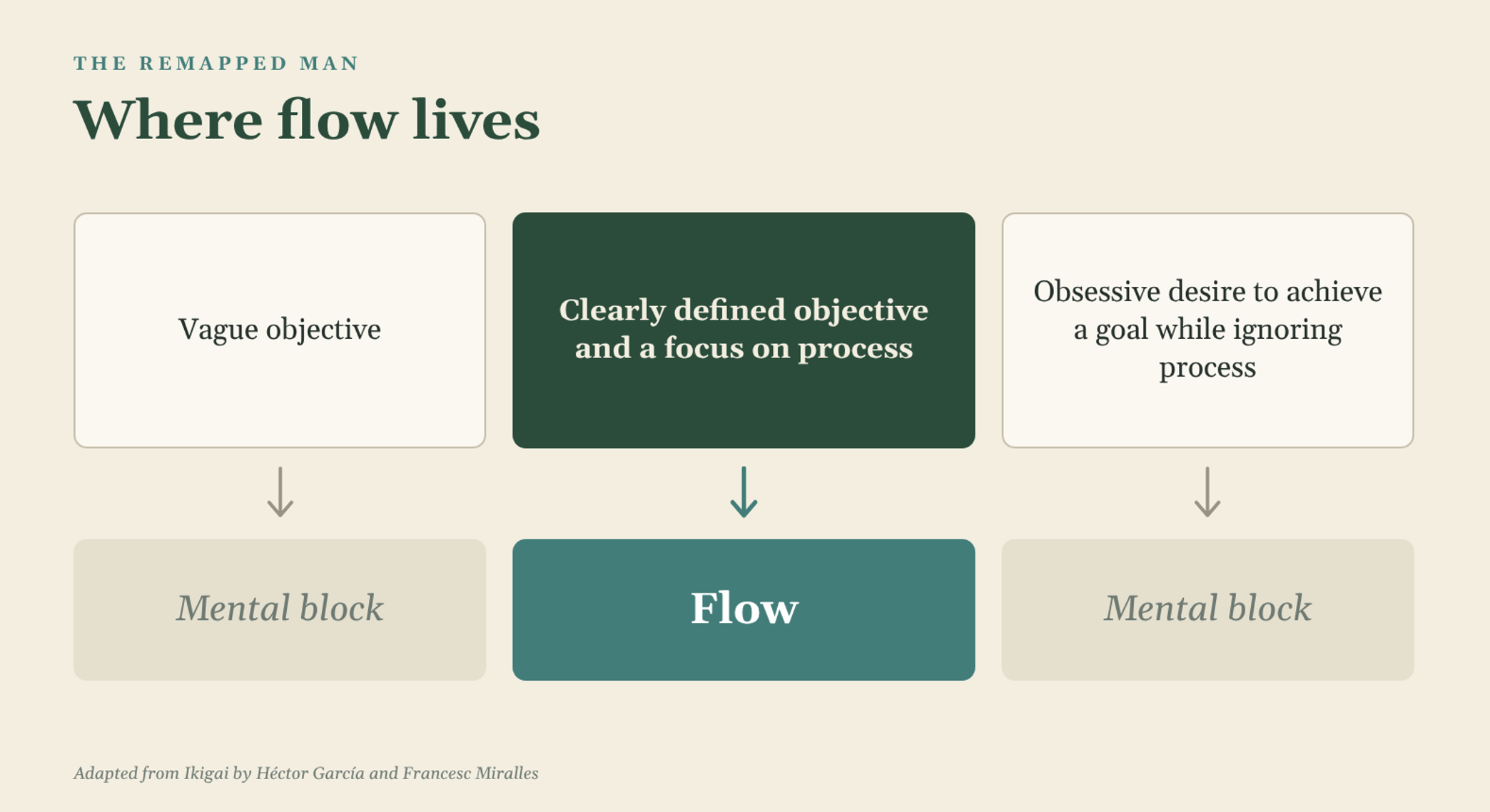
Before the book gets to multitasking, it sets out a simple idea. It's the image at the top of this post. There are three ways to approach a goal, and only one of them leads to flow.
· A vague objective leads to a mental block. You don't really know what you're aiming at, so you can't fully commit to it.
· An obsessive desire to hit a goal while ignoring the process also leads to a block. You're so fixed on the result that you can't settle into the work.
· A clearly defined objective, with your attention on the process, leads to flow.
I see both blocks in the men I coach. Some have drifted into vagueness. They hit the goals they set in their twenties and never set new ones that meant anything. Others are locked on the next milestone. The promotion. The number. The bigger house. They're so focused on getting there that they've stopped noticing the life they're living on the way.
Underneath, both are questions of identity. If you don't know who you are now, it's hard to know what you're aiming at. And if your sense of worth lives in the result, the process will always feel like something to rush through.
There's no such thing as multitasking
The authors' third strategy for flow is simple to say and hard to do. Concentrate on a single task.
Their point is that our brains can take in a vast amount of information but can only process a small amount of it at any moment. So what we call multitasking is really switching. Back and forth, very quickly. We aren't built for parallel processing. We end up spending our energy on the switching instead of doing any one thing well.
They go as far as saying that concentrating on one thing at a time may be the single most important factor in reaching flow.
Drawing on Mihaly Csikszentmihalyi, the psychologist who first described flow, they name two conditions for real focus. A space free of distractions. And control over what we're doing from one moment to the next.
That second one matters. Technology is a great servant when we're in charge of it. The trouble starts when it's in charge of us. You open a browser to look up one fact for a report. An hour later you're somewhere else entirely and the report hasn't moved.
Red and blue
The book points to research at Stanford by the late Clifford Nass. His team compared people who habitually juggled lots of things at once with people who didn't. Each group was shown a screen of red and blue shapes and asked to pay attention only to the red ones.
At first everyone coped. As more blue shapes appeared, the heavy multitaskers started to struggle. Not because they were less able. Because their brains had been trained to treat every stimulus as worth noticing, whether it mattered or not. The others had trained their brains to focus on one thing and ignore the rest.
That's the part that stayed with me. Constant switching doesn't just waste time and lead to more mistakes. It changes what your mind thinks is important. When everything gets your attention, nothing really does.
What single-tasking gives you
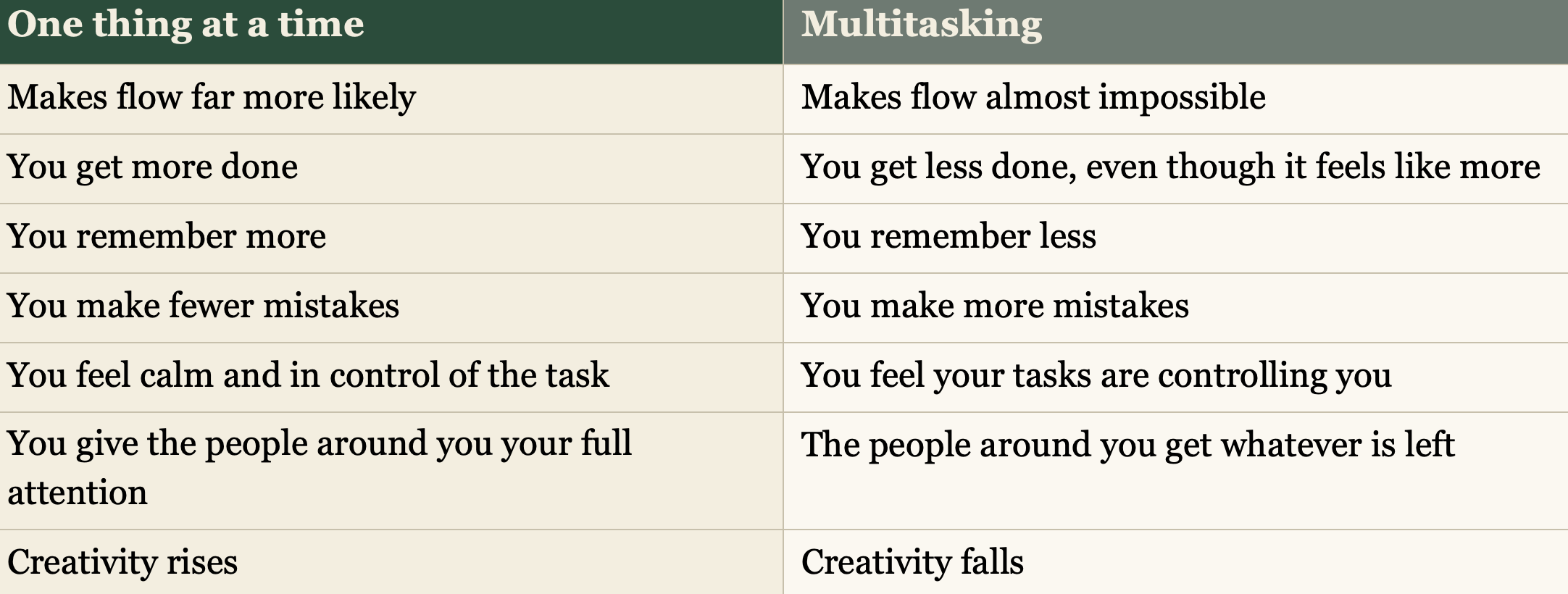
The book sets out the difference in a simple comparison. Here it is in my words.
Single tasking is better! - Adapted from Ikigai by Héctor García and Francesc Miralles
Look at the fifth line. The feeling that your tasks are running you.
For a lot of high-achieving men, that's the story of the last ten years. The inbox decided the morning. The diary decided the week. Somewhere along the way the job started running the man, rather than the other way round. That's often when the bigger question arrives. Who am I when I'm not responding to something?
How to build focus
The book offers a set of practical ideas for creating time and space free of distraction. These are the ones it recommends.
· No screens for the first hour after you wake and the last hour before you sleep.
· Turn your phone off before you start focused work. If that feels too much, use do not disturb so only the people closest to you can get through.
· Pick one day a week, perhaps Saturday or Sunday, as a break from technology.
· Work somewhere without Wi-Fi. A café, a library, or anywhere that suits the task.
· Read and answer email once or twice a day, at set times, and stick to them.
· Try the Pomodoro Technique. Twenty-five minutes on one task, then five minutes' rest. Or fifty and ten. The key is completing each cycle.
· Start each work session with a ritual you enjoy and finish it with a reward.
· When your mind wanders, bring it back to the present. Meditation, a walk or a swim can help.
· Group related tasks and give each group its own time and place.
· Bundle routine jobs, like invoices and phone calls, and do them all in one go.
None of this is complicated. It's just rarely done.
Flow or distraction
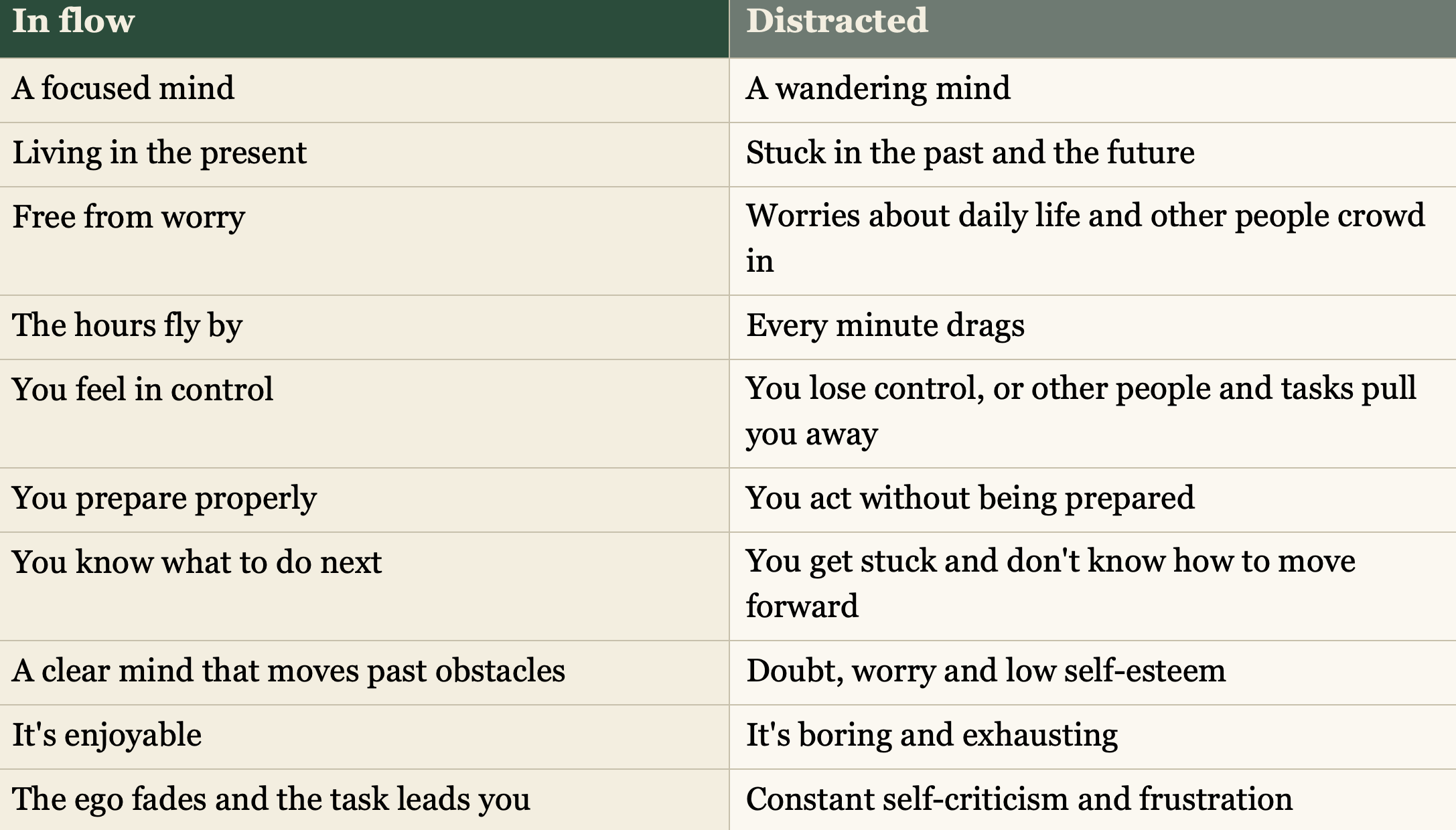
The chapter closes with a second comparison. Again, in my words.
Adapted from Ikigai by Héctor García and Francesc Miralles
That last line is the one I'd sit with.
Many of the men I coach describe being trapped in their own heads. Constant self-judgement. Always watching, always measuring. Flow is one of the few places that voice goes quiet. Not because you've beaten it. Because you're too absorbed to listen.
And that's often where a man starts to find himself again. Not by thinking harder about who he is. By being fully in something that matters to him.
One thing at a time
The book's bigger point is that flow is one of the ways we get in touch with our ikigai. Our reason for getting up in the morning.
So next time you sit down to write that email, close the other tabs. Put the phone in another room. Give one thing all of you, just for twenty-five minutes.
It might feel strange at first. That's often the first sign you're finding your way back.
If this has struck a chord, and you'd like to talk about where your attention is going and who it's quietly turning you into, I'm always happy to have a conversation. No pressure. Just a chat.
#TheRemappedMan #IdentityRemapping #Multitasking #Focus #FlowState #Ikigai #SingleTasking #DeepWork #MensCoaching #MidLife #MensMentalHealth #Presence #DigitalDistraction #PersonalDevelopment #HighAchievers
Russ Bignell — The Remapping Coach
Russ Bignell works with high-achieving men who sense a gap between the life they've built and the one they actually want to be living. He's been that man himself, which is why he knows that more effort, more discipline, and more self-improvement content rarely closes it.
His work sits at the intersection of identity shift, behaviour change, and neuroscience, helping men understand not just what needs to change, but who they need to become for that change to last.
Russ uses his Remapped Man concept to work with men across the UK and internationally. The men he works with leave clearer on who they are, more deliberate in how they show up, and finally able to close the gap between the man they've been and the one they know they could be.